The very first book that I am assigned to read for my graduate program is The Order of Books by Roger Chartier (Stanford University Press, 1992.) It is a series of three essays that examine the changes to reading and books between the middle ages and the eighteenth century. The first essay, titled "Communities of Readers," consider how reading was transformed through the invention of the Gutenberg press from something reserved for the wealthy to something that was more accessible to regular people through the ability to mass produce more books for consumption. Chartier states his question to be, "how did increased circulation of printed matter transform forms of sociability, permit new modes of thought, and change people's relationship with power?" (p. 3). He says, There is a relationship between reader and writer that is bound by customs and criticism. Charier has dual presuppositions a. "reading is not already inscribed in the text with no conceivable gap between the meaning assigned to it and the interpretation that its readers might make of it; and, as a corollary, that a text exists only because there is a reader to give it meaning. He also notes that "reading is always a practice embodied in acts, spaces, and habits. In addition, he explores the construction of reading from something that is done through oral vocalizations to something that is done in silence.
One of the central things that I bring to this book is my own ruminations about books, the creation of books, and, in the case of the first chapter, the creation of readers and audiences for books and writers. This has been on my mind powerfully as a poet because a central question of being a poet and writing poems is wondering how to find the readers for the poems. Particularly for me as a lesbian-feminist poet and writer. When I took a day long writing workshop with Minnie Bruce Pratt, she unequivocally stated that we must take control of our audience and create our own publications to reach our readers. She said that this is what she did as a young poet and feminist, in particular in conjunction with the Feminary Collective. I found this very powerful at the time and in fact still do. It propelled me to explore creating my own postcards, broadsides, and hand-stitched "chaplet." Finding an audience, a community of readers as Chartier calls it, is not just something that happened in the sixteenth, seventeenth, and eighteenth centuries, I think it is a critical and central question for writers and readers today. Certainly there are some different implications, but the underlying issues are the same.
The second essay of The Order of Books is titled, "Figures of the Author." It takes up the questions of single authorial ownership and how that emerged. Chartier writes, "in the latter half of the eighteenth century a somewhat paradoxical connection was made between a desired professionalization of literary activity (which should provide remuneration in order for writers to live from their writings) and the authors' representation of themselves in an ideology of literature founded on the radical autonomy of the work of art and the disinterestedness of the creative act." There was a paradoxical tension in which there was an ability to move from writers relying exclusively on patronage to supporting themselves through book sale and distribution, but both economic realities worked against the imagined idealization of writers and written works of art being "inspired" and somehow outside of the economic system. I think that this paradox is still operational today. It is one of the theoretical underpinnings of my "Queer Culture" essay. We want to have inspired and powerful examples of queer cultural work, but we don't necessarily want to understand the economic environment in which those happen.
The chapter on the Author also deals with how legal understandings of copyright evolved during these periods and impacted how authors were viewed and created as a cultural figure. Most significantly, Chartier writes that "in 1784, two ancient models for the author's condition remained dominant: the writer either enjoyed an economic independence assured by birth or profession or lived on gratifications and sinecures procured from patronage. The new phenomenon of a social status founded solely on the remuneration of writing emerged only with difficulty within the mental framework of the ancien regime" (p. 48.) It is interesting how much later than the Gutenberg Press this notion of economic independence for writers emerged; Gutenberg made his first press in 1450. Moreover, further evolution has happened for the figure of the author; most particularly other forms of support have emerged: the author as academic and the author as journalist. I'm interested in that evolution, but Chartier doesn't address it as it is a much more modern emergence.
The question of authorship is interesting because of the recent controversies about authorship (James Frey, for instance, and Kaavya Viswanatha, the young woman who apparently plagiarized part of the "chick lit" book that she wrote for a substantial advance for a large publishing company), but also because of how authorship is being impacted and changed by the Internet. Certainly, anonymous authorship is more possible on the Internet, but I would also argue that there is more collaborative authorship possibilities because of the Internet. First, authors and like-minded writers can find one another more easily because of email and the web. Second, they can exchange information and ideas more quickly. As an example, I submit a weblog in which I participate, Woman-Stirred, as an example. There are five of us that contribute to the blog postings; we discuss posting via email often, though not always, in advance; each of us can post individually and we have a collective posting option. I've been involved for just about a year now and it has evolved throughout that time. I would never consider it an individual blog-though I have made some individual postings. It is a collective blog with collective authorship. I think that it is changing some of the notions of authorship as Chartier outlines them in this book.
The final essay is titled "Libraries without Walls." It chronicles the development of libraries in the early years of mass production of books. A central question of the class that I am taking is, Are libraries necessary? I want to take up that idea later in a separate post. I'll just say that one of the profound experiences that I had at school was the orientation to McKeldin Library. There are so many resources available to me as a student and it was an incredible relief and sense of validation as a scholar to have those resources suddenly available to me after toiling for the last few years to think and write and work without them. While I have always heralded the Internet as a great equalizer for information and ideas and reveled in the resources that I have had for my work from it, seeing what is available now to me, demonstrates how limited I was before.
The question of libraries though is also one for the Internet. One of the projects that I completed this summer was "publishing" my essay on "Queer Culture." It is a photocopied folio and it is published online at Woman-Stirred. Experimenting with those two forms of publishing was incredibly thought-provoking and stimulating. First, to be able to control my release of it was empowering and Minnie Bruce Pratt said that it would be. It also highlighted my limitations. I'd like a good editor. I'd like more editorial feedback in my writing process. It is exhausting and challenging to produce everything oneself. It is also challenging to figure out how to get it out to readers. I've mailed out about 40 copies and given many copies away. It is a balance between feeling incredibly narcissistic for putting my ideas out there and knowing that if I don't do it no one else will. This independent publishing, though, is outside of libraries and in many ways inaccessible to libraries. That is something that must be overcome because I think that libraries are such an essential part of our collective history.
Ultimately, I think that part of what is happening in the world today in relationship to the Internet is similar to what happened with the creation of books through moveable type. There is a new means of production for things to be published, i.e. on the web or on email, and we are seeing the changes that evolve in conjunction wtih that. Technological changes are impacting publishers, but they are also impacting readers - how we find readers, how readers expect to encounter texts - and writers. I'm interested in how this evolution can be used for queer liberation and queer culture and I'm interested in my ideas about that being informed by sound history.
This journey will continue.
Sunday, September 10, 2006


Saturday, September 09, 2006
Friday, September 08, 2006
Check out my column in the Washington Blade
Getting over coming outy)
Exiting the closet was never a good strategy for winning equality. Societal problems require collective action.
By JULIE ENSZER Friday, September 08, 2006
IT’S BEEN A hard conclusion for me to embrace. I organized “Speak Outs” for National Coming Out Day in the 1990s. I advocated coming out as critical to our liberation.
I’ve come out to everyone and reveled it in. When I ran out of family members, I moved on to dry cleaners and grocery baggers and state senators and plumbers and metro passengers. I can’t think of a person I haven’t told.
Even still, it’s come time for me to admit that coming out is a flawed strategy. In fact, coming out is the wrong strategy for queer liberation.
Read the full column here.
By JULIE ENSZER Friday, September 08, 2006
IT’S BEEN A hard conclusion for me to embrace. I organized “Speak Outs” for National Coming Out Day in the 1990s. I advocated coming out as critical to our liberation.
I’ve come out to everyone and reveled it in. When I ran out of family members, I moved on to dry cleaners and grocery baggers and state senators and plumbers and metro passengers. I can’t think of a person I haven’t told.
Even still, it’s come time for me to admit that coming out is a flawed strategy. In fact, coming out is the wrong strategy for queer liberation.
Read the full column here.
Thursday, September 07, 2006
Jane Caputi
I know Jane Caputi best as the collaborator with Mary Daly on Wickedary. I am an admirer of Mary Daly's work because of the breadth of it's vision and because in addition to having a radical analysis as a feminist and ecologist, she has a relationship to the Catholic Church via her training as a theologian and her former affiliation with Boston College. Daly has always fascinated me.
Today though I read an interesting squib about Jane Caputi. Someone emailed this to a list that I am on:
The Pornography of Everyday Life
A 33-minute film written by Jane Caputi
"Pornography" (sexualized domination and objectification of women and
others put in the role of women) is really a mainstream worldview, one
supporting not only sexism, but also racism, militarism and environmental
destruction. Pornography as such appears not only in overt, but also in
everyday forms like ads and other forms of pop culture. While pornographic
imagery is usually thought to be the opposite of religion, it actually is a
form of patriarchal religion and works by appropriating previously sacred
icons and images of women, sex, and the feminine principle and then
profaning and defaming them. To resist, visionary artists and thinkers
re-imagine female sexuality and/or the female divine, restoring respect to
the feminine principle, and calling for new understandings of sex, mystery,
connection, eroticism, and ecstasy.
A DVD is available for $25.00. That sum covers costs of duplication,
shipping and handling; part of each payment will be donated to the Feminist
Scholarship Fund, Boca Raton, Florida. If you are interested, please send a
check made out to Jane Caputi, LLC, to Prof. Jane Caputi, Women's Studies,
Florida Atlantic University, Boca Raton, FL 33431.
A google search revealed no more about the film, but it sounds quite interesting and like an outgrowth of some work that Caputi has done in her other books. Caputi's work is not adequately captured in her books, however; this syllabus provides more insight into her thinking and work as a feminist.
I would consider Caputi and Daly "deep ecologists" and "ecofeminists."
Now if only someone would buy this DVD and put it on YouTube. . . . .
Today though I read an interesting squib about Jane Caputi. Someone emailed this to a list that I am on:
The Pornography of Everyday Life
A 33-minute film written by Jane Caputi
"Pornography" (sexualized domination and objectification of women and
others put in the role of women) is really a mainstream worldview, one
supporting not only sexism, but also racism, militarism and environmental
destruction. Pornography as such appears not only in overt, but also in
everyday forms like ads and other forms of pop culture. While pornographic
imagery is usually thought to be the opposite of religion, it actually is a
form of patriarchal religion and works by appropriating previously sacred
icons and images of women, sex, and the feminine principle and then
profaning and defaming them. To resist, visionary artists and thinkers
re-imagine female sexuality and/or the female divine, restoring respect to
the feminine principle, and calling for new understandings of sex, mystery,
connection, eroticism, and ecstasy.
A DVD is available for $25.00. That sum covers costs of duplication,
shipping and handling; part of each payment will be donated to the Feminist
Scholarship Fund, Boca Raton, Florida. If you are interested, please send a
check made out to Jane Caputi, LLC, to Prof. Jane Caputi, Women's Studies,
Florida Atlantic University, Boca Raton, FL 33431.
A google search revealed no more about the film, but it sounds quite interesting and like an outgrowth of some work that Caputi has done in her other books. Caputi's work is not adequately captured in her books, however; this syllabus provides more insight into her thinking and work as a feminist.
I would consider Caputi and Daly "deep ecologists" and "ecofeminists."
Now if only someone would buy this DVD and put it on YouTube. . . . .
Casa Susanna - article from the NY Times
An interesting piece in the New York Times today about a place where transvestites gathered during the early 1960s. My favorite part of the article is the final sentence in which Judith Butler and Phil Donahue are mentioned together. I had no idea that Butler was at that level or in fact that Donahue was "at that level."
It's an interesting read. I feel like I am building up to writing something more substantive about transgender issues. If I ever have the time.
September 7, 2006
A Safe House for the Girl Within
By PENELOPE GREEN
THERE was a pilot and a businessman, an accountant, a librarian and a pharmacologist. There was a newspaper publisher, and a court translator. By day, they were the men in the gray flannel suits, but on the weekends, they were Felicity, Cynthia, Gail, Sandy, Fiona, Virginia and Susanna. It was the dawn of the 1960’s, yet they wore their late 50’s fashions with awkward pride: the white gloves, the demure dresses and low heels, the stiff wigs. Many were married with children, or soon would be. In those pre-Judith Butler, pre-Phil Donahue days, when gender was more tightly tethered to biology, these men’s “gender migrations,” or “gender dysphoria,” as the sociologists began to call cross-dressing, might cost them their marriages, their jobs, their freedom.
And so they kept their feminine selves hidden, except for weekends at Casa Susanna, a slightly run-down bungalow camp in Hunter, N.Y., that was the only place where they could feel at home.
Decades later, when Robert Swope, a gentle punk rocker turned furniture dealer, came across their pictures — a hundred or so snapshots and three photo albums in a box at the 26th Street flea market in Manhattan — he knew nothing about their stories, or Casa Susanna, beyond the obvious: here was a group of men dressed as women, beautiful and homely, posing with gravity, happiness and in some cases outright joy. They were playing cards, eating dinner, having a laugh. They didn’t look campy, like drag queens vamping it up as Diana Ross or Cher; they looked like small-town parishioners, like the lady next door, or your aunt in Connecticut.
Mr. Swope was stunned by the pictures and moved by the mysterious world they revealed. He and his partner, Michel Hurst, gathered them into a book, “Casa Susanna,” which was published by Powerhouse Books in 2005 and reissued last spring, and which became an instant sensation, predictably, in the worlds of fashion and design. Paul Smith stores sold it, as did the SoHo design store and gallery Moss, which made a Christmas diorama of a hundred copies last year. Last month, you might have seen it in the hands of a child-size mannequin in the Marc Jacobs store on Bleecker Street.
But it was only after the book’s publication that Mr. Swope and Mr. Hurst began to learn the story of Casa Susanna, first called the Chevalier d’Eon resort, for an infamous 18th-century cross-dresser and spy, and only in recent months, as they have begun working on a screenplay about the place, that they have come to know some of its survivors.
“At first, I didn’t want to know more,” Mr. Swope said. “I didn’t want to find out that the stories turned out to be tragedies.”
But the publication of the book has drawn former Casa Susanna guests out, and it turns out that their stories, like most, have equal measures of tragic and comic endings. Some are still being told.
Robert Hill, a doctoral candidate in the American studies program at the University of Michigan who is completing his dissertation on heterosexual transvestism in post-World War II America, came across Mr. Swope and Mr. Hurst’s book by accident in a Borders last year, reached out to them through their publisher, and sketched in many of the details.
Casa Susanna was owned by Susanna herself — the court translator, otherwise known as Tito Valenti — and Valenti’s wife, Marie, who conveniently ran a wig store on Fifth Avenue and was happy to provide makeover lessons and to cook for the weekend guests. It was a place of cultivated normalcy, where Felicity, Cynthia, Gail, Fiona and the others were free to indulge their radical urges to play Scrabble in a dress, trade makeup tips or walk in heels in the light of day.
“These men had one foot in the mainstream and the other in the margins,” Mr. Hill said the other day. “I’m fascinated by that position and their paradox, which is that the strict gender roles of the time were both the source of their anxiety and pain, and also the key to escaping that pain.”
What still moves Murray Moss, the impresario behind Moss the store, about the images in the book is their ordinariness. “You think of man dressed as woman and you think extremes: it’s kabuki, Elizabethan theater, Lady Macbeth,” he said. “It’s also sexual. But these aren’t sexual photos. The idea that they formed a secret society just to be ... ordinary. It’s like a mirror held up to convention. It’s not what you would expect. It’s also not pathetic. Everybody looks so happy.”
At first, Casa Susanna was a thrilling place, said Sandy, a divorced businessman, “because whatever your secret fantasies were you were meeting other people who had similar ones and you realized, ‘I might be different but I’m not crazy.’ ” Now 67 and living in the Northeast, he hasn’t cross-dressed for decades, and asked that his identifying details be veiled. He was a graduate student in 1960, he said, living in New York and visiting Casa Susanna on the weekends.
“It was the most remarkable release of pressure, and it meant the world to me then,” he said. “I’d grown up in a very conventional family. I had the desire to marry, to have the house, the car, the dog. And I eventually did. But at that point there were all these conflicting desires that had no focal points. I didn’t know where I fit.”
Sandy remembers one weekend sharing a cabin with another man and his girlfriend. “She obviously accepted the situation with him for better or worse,” Sandy began. “Anyway, I didn’t get dressed until later in the day, and when I did, the girlfriend was just coming down the stairs. ‘Oh my,’ she said, ‘you certainly have made a change. I have to tell you, I much preferred the person who got out of the car.’ And with that she reached under my dress and groped me. She said, ‘It’s a shame to have all that locked up in there.’ In one sense, it was titillating, in another, depressing. And yet in another way, it put a finger on the issue.”
Casa Susanna was a testing ground for many. Katherine Cummings, who went by Fiona at Casa Susanna, was born John Cummings in Scotland 71 years ago. Now living in Sydney, she has been a transsexual for more than 20 years, as well as a librarian and an editor. When she was 28, she took a post-doctoral degree in Toronto, and spent her weekends at Casa Susanna, the first place, she said last week, where she could dress openly. In her 1992 memoir, “Katherine’s Diary,” she writes hilariously about a late October weekend, shivering in the cold bungalows, and accepting a ride from the main house down to the cabin she had been assigned with a burly man in slipshod makeup and a slapped-on wig. She turned to the back seat and froze: there lay a nightstick, handcuffs and other police paraphernalia. Turns out her chauffeur was the sheriff of a small New Jersey town.
The resort catered to hunters as well, Ms. Cummings said, and sometimes there was overlap. “Libby, who was very beautiful, was also Lee, who was a very macho person. And one day the hunters were there and so were we and they all had a great time discussing rifles.”
Mostly the guests talked and talked. “They talked about fashion, and passing, and how and if they’d told their wives or girlfriends,” said Ms. Cummings, who is divorced and has three daughters. “In those days we didn’t know where we were going.”
They had parties, and even a convention of sorts, one Halloween in 1962, that drew cross-dressers from all over the country, as well as a few psychologists from the Kinsey Institute. Led by the irascible pharmacologist Virginia Prince, who made them their own magazine, Transvestia, for which Susanna was a columnist dispensing exhortatory advice and tips on deportment and makeup, many of them formed a loose collective that decades later grew into a not-so-secret society called Tri-Ess (a k a the Society for the Second Self).
“I remember the first morning we all arrived,” Ms. Prince said last week, “and all these, let’s just call them people, descended on the bathrooms and you see all these folks in their nighties and kimonos and so forth standing around shaving. It was a very amusing sight. Beards tend to grow. I had mine removed years ago.”
Ms. Prince became known as the founder of the transgender movement, and wrote copiously on the subject for science and sex research journals and conferences, irritating more than a few Casa Susanna graduates, who weren’t comfortable with the politicizing of their issues, or the strict categories she created. Born male (and still biologically male), she has been living as a woman for the past 40 years. At 94, she’s no longer allowed to drive, but she leads the Lollies (“little old ladies like me,” she said the other day) at her California retirement home in a study group (they’re covering astronomy this month) and drives a red scooter.
“I invented gender,” she said proudly. “Though if the ladies here find out I’m a biological man I’m a dead duck.”
Of Susanna herself, the trail ends with her last column for Transvestia in 1970, when she, like Virginia, announced her plans to live henceforth as a woman.
“Scene: The porch in the main house at our resort in the Catskill Mountains,” Susanna writes in a snippet from one of her early columns, courtesy of Mr. Hill’s research, and trimmed a bit. “The time: About 4 o’clock in the morning as Labor Day is ready to awaken in the distant darkness. The cast: Four girls just making small talk. ... It’s dark in the porch; just a row of lights illuminate part of the property at intervals — perhaps a bit chilly at 2,400 feet. ... An occasional flame lighting a cigarette throws a glow on feminine faces — just a weekend at the resort, hours in which we know ourselves a little better by seeing our image reflected in new colors and a new perspective through the lives of new friends.”
It's an interesting read. I feel like I am building up to writing something more substantive about transgender issues. If I ever have the time.
September 7, 2006
A Safe House for the Girl Within
By PENELOPE GREEN
THERE was a pilot and a businessman, an accountant, a librarian and a pharmacologist. There was a newspaper publisher, and a court translator. By day, they were the men in the gray flannel suits, but on the weekends, they were Felicity, Cynthia, Gail, Sandy, Fiona, Virginia and Susanna. It was the dawn of the 1960’s, yet they wore their late 50’s fashions with awkward pride: the white gloves, the demure dresses and low heels, the stiff wigs. Many were married with children, or soon would be. In those pre-Judith Butler, pre-Phil Donahue days, when gender was more tightly tethered to biology, these men’s “gender migrations,” or “gender dysphoria,” as the sociologists began to call cross-dressing, might cost them their marriages, their jobs, their freedom.
And so they kept their feminine selves hidden, except for weekends at Casa Susanna, a slightly run-down bungalow camp in Hunter, N.Y., that was the only place where they could feel at home.
Decades later, when Robert Swope, a gentle punk rocker turned furniture dealer, came across their pictures — a hundred or so snapshots and three photo albums in a box at the 26th Street flea market in Manhattan — he knew nothing about their stories, or Casa Susanna, beyond the obvious: here was a group of men dressed as women, beautiful and homely, posing with gravity, happiness and in some cases outright joy. They were playing cards, eating dinner, having a laugh. They didn’t look campy, like drag queens vamping it up as Diana Ross or Cher; they looked like small-town parishioners, like the lady next door, or your aunt in Connecticut.
Mr. Swope was stunned by the pictures and moved by the mysterious world they revealed. He and his partner, Michel Hurst, gathered them into a book, “Casa Susanna,” which was published by Powerhouse Books in 2005 and reissued last spring, and which became an instant sensation, predictably, in the worlds of fashion and design. Paul Smith stores sold it, as did the SoHo design store and gallery Moss, which made a Christmas diorama of a hundred copies last year. Last month, you might have seen it in the hands of a child-size mannequin in the Marc Jacobs store on Bleecker Street.
But it was only after the book’s publication that Mr. Swope and Mr. Hurst began to learn the story of Casa Susanna, first called the Chevalier d’Eon resort, for an infamous 18th-century cross-dresser and spy, and only in recent months, as they have begun working on a screenplay about the place, that they have come to know some of its survivors.
“At first, I didn’t want to know more,” Mr. Swope said. “I didn’t want to find out that the stories turned out to be tragedies.”
But the publication of the book has drawn former Casa Susanna guests out, and it turns out that their stories, like most, have equal measures of tragic and comic endings. Some are still being told.
Robert Hill, a doctoral candidate in the American studies program at the University of Michigan who is completing his dissertation on heterosexual transvestism in post-World War II America, came across Mr. Swope and Mr. Hurst’s book by accident in a Borders last year, reached out to them through their publisher, and sketched in many of the details.
Casa Susanna was owned by Susanna herself — the court translator, otherwise known as Tito Valenti — and Valenti’s wife, Marie, who conveniently ran a wig store on Fifth Avenue and was happy to provide makeover lessons and to cook for the weekend guests. It was a place of cultivated normalcy, where Felicity, Cynthia, Gail, Fiona and the others were free to indulge their radical urges to play Scrabble in a dress, trade makeup tips or walk in heels in the light of day.
“These men had one foot in the mainstream and the other in the margins,” Mr. Hill said the other day. “I’m fascinated by that position and their paradox, which is that the strict gender roles of the time were both the source of their anxiety and pain, and also the key to escaping that pain.”
What still moves Murray Moss, the impresario behind Moss the store, about the images in the book is their ordinariness. “You think of man dressed as woman and you think extremes: it’s kabuki, Elizabethan theater, Lady Macbeth,” he said. “It’s also sexual. But these aren’t sexual photos. The idea that they formed a secret society just to be ... ordinary. It’s like a mirror held up to convention. It’s not what you would expect. It’s also not pathetic. Everybody looks so happy.”
At first, Casa Susanna was a thrilling place, said Sandy, a divorced businessman, “because whatever your secret fantasies were you were meeting other people who had similar ones and you realized, ‘I might be different but I’m not crazy.’ ” Now 67 and living in the Northeast, he hasn’t cross-dressed for decades, and asked that his identifying details be veiled. He was a graduate student in 1960, he said, living in New York and visiting Casa Susanna on the weekends.
“It was the most remarkable release of pressure, and it meant the world to me then,” he said. “I’d grown up in a very conventional family. I had the desire to marry, to have the house, the car, the dog. And I eventually did. But at that point there were all these conflicting desires that had no focal points. I didn’t know where I fit.”
Sandy remembers one weekend sharing a cabin with another man and his girlfriend. “She obviously accepted the situation with him for better or worse,” Sandy began. “Anyway, I didn’t get dressed until later in the day, and when I did, the girlfriend was just coming down the stairs. ‘Oh my,’ she said, ‘you certainly have made a change. I have to tell you, I much preferred the person who got out of the car.’ And with that she reached under my dress and groped me. She said, ‘It’s a shame to have all that locked up in there.’ In one sense, it was titillating, in another, depressing. And yet in another way, it put a finger on the issue.”
Casa Susanna was a testing ground for many. Katherine Cummings, who went by Fiona at Casa Susanna, was born John Cummings in Scotland 71 years ago. Now living in Sydney, she has been a transsexual for more than 20 years, as well as a librarian and an editor. When she was 28, she took a post-doctoral degree in Toronto, and spent her weekends at Casa Susanna, the first place, she said last week, where she could dress openly. In her 1992 memoir, “Katherine’s Diary,” she writes hilariously about a late October weekend, shivering in the cold bungalows, and accepting a ride from the main house down to the cabin she had been assigned with a burly man in slipshod makeup and a slapped-on wig. She turned to the back seat and froze: there lay a nightstick, handcuffs and other police paraphernalia. Turns out her chauffeur was the sheriff of a small New Jersey town.
The resort catered to hunters as well, Ms. Cummings said, and sometimes there was overlap. “Libby, who was very beautiful, was also Lee, who was a very macho person. And one day the hunters were there and so were we and they all had a great time discussing rifles.”
Mostly the guests talked and talked. “They talked about fashion, and passing, and how and if they’d told their wives or girlfriends,” said Ms. Cummings, who is divorced and has three daughters. “In those days we didn’t know where we were going.”
They had parties, and even a convention of sorts, one Halloween in 1962, that drew cross-dressers from all over the country, as well as a few psychologists from the Kinsey Institute. Led by the irascible pharmacologist Virginia Prince, who made them their own magazine, Transvestia, for which Susanna was a columnist dispensing exhortatory advice and tips on deportment and makeup, many of them formed a loose collective that decades later grew into a not-so-secret society called Tri-Ess (a k a the Society for the Second Self).
“I remember the first morning we all arrived,” Ms. Prince said last week, “and all these, let’s just call them people, descended on the bathrooms and you see all these folks in their nighties and kimonos and so forth standing around shaving. It was a very amusing sight. Beards tend to grow. I had mine removed years ago.”
Ms. Prince became known as the founder of the transgender movement, and wrote copiously on the subject for science and sex research journals and conferences, irritating more than a few Casa Susanna graduates, who weren’t comfortable with the politicizing of their issues, or the strict categories she created. Born male (and still biologically male), she has been living as a woman for the past 40 years. At 94, she’s no longer allowed to drive, but she leads the Lollies (“little old ladies like me,” she said the other day) at her California retirement home in a study group (they’re covering astronomy this month) and drives a red scooter.
“I invented gender,” she said proudly. “Though if the ladies here find out I’m a biological man I’m a dead duck.”
Of Susanna herself, the trail ends with her last column for Transvestia in 1970, when she, like Virginia, announced her plans to live henceforth as a woman.
“Scene: The porch in the main house at our resort in the Catskill Mountains,” Susanna writes in a snippet from one of her early columns, courtesy of Mr. Hill’s research, and trimmed a bit. “The time: About 4 o’clock in the morning as Labor Day is ready to awaken in the distant darkness. The cast: Four girls just making small talk. ... It’s dark in the porch; just a row of lights illuminate part of the property at intervals — perhaps a bit chilly at 2,400 feet. ... An occasional flame lighting a cigarette throws a glow on feminine faces — just a weekend at the resort, hours in which we know ourselves a little better by seeing our image reflected in new colors and a new perspective through the lives of new friends.”
Oscar Wilde
In August, I had one poem accepted for publication in Earth's Daughters, which thrilled me because it is such a venerable feminist publication, and two other poems accepted for publication in upcoming anthologies. In addition, I was honorably mentioned in the 2006 Gival Press Oscar Wilde Award. The full information is below. While I still subscribe to the Suzette Charles theory of winning contests (which goes something like, no one ever remembers the runner-up, to wit, who became Miss America after Vanessa Williams?), it was a nice moment to learn this. To what do I attribute this flurry of positive feedback from the world? Stanley Plumly, without a doubt.
Dante Micheaux Wins the Fifth Annual Oscar Wilde Award-2006
Gival Press is pleased to announce that Dante Micheaux of New York City has won the Fifthh Annual Oscar Wilde Award for his poem entitled Bread Boy.
Dante Micheaux received a cash prize of $100.00 and his poem is posted below.
In addition, in 2008 his poem will appear in the anthology Poetic Voices Without Borders 2, which will include the top poems entered in the contest.
Winner of the 2006 Gival Press Oscar Wilde Award
Bread Boy
by Dante Micheaux of New York, New York.
Honorable Mentions:
If my father dressed as a woman
by Teresa Stores of Newtane, Vermont.
Testing Abraham
by Julie R. Enszer of University Park, Maryland.
Viscous
by Ed Madden of Columbia, South Carolina.
Kate's Pantoum
by Jennifer Pruden Colligan of Nassau, New York.
http://chezrobertgiron.blogspot.com/2006/08/dante-micheaux-wins-oscar-wilde-award.html
Dante Micheaux Wins the Fifth Annual Oscar Wilde Award-2006
Gival Press is pleased to announce that Dante Micheaux of New York City has won the Fifthh Annual Oscar Wilde Award for his poem entitled Bread Boy.
Dante Micheaux received a cash prize of $100.00 and his poem is posted below.
In addition, in 2008 his poem will appear in the anthology Poetic Voices Without Borders 2, which will include the top poems entered in the contest.
Winner of the 2006 Gival Press Oscar Wilde Award
Bread Boy
by Dante Micheaux of New York, New York.
Honorable Mentions:
If my father dressed as a woman
by Teresa Stores of Newtane, Vermont.
Testing Abraham
by Julie R. Enszer of University Park, Maryland.
Viscous
by Ed Madden of Columbia, South Carolina.
Kate's Pantoum
by Jennifer Pruden Colligan of Nassau, New York.
http://chezrobertgiron.blogspot.com/2006/08/dante-micheaux-wins-oscar-wilde-award.html
Tuesday, September 05, 2006
Silly Observations about School
Today I got my student ID for the University of Maryland. On it is "Graduate Student." I cam back to my office and set it on my computer keyboard and just looked at it a good part of the day feeling delighted. I'm so pleased to be in the MFA program at Maryland. That pleasure is evident on the ID - my smile is that of the cheshire cat, my signature is large - the J runs off of the screen. In addition to this joy of getting the student ID, I also had my first day at school that didn't involve crying as a result of anxiety. Last week, on the two days that I had classes, I cried - mainly in the parking garage and came within a breath of just not going to the classes. Then, unable to really determine where I was to buy my books, I cried in the middle of the tropical storm on Friday. Today, though, no tears; just a gorgeous student ID.
Beyond the silly though, one thing that struck me today about school is that for the past fifteen years, I've really been paid to make decisions, generally quick decisions within the constraints of inadequate information and resources. That is what has been prized and rewarded for me professionally for fifteen years: quick decisions within large constraints. Now, in academia, quick decisions, quick judgments are not of interest. What is valued is not decisions and judgments, quick or slow (well perhaps reasoned, slow decisions and judgments are valued, but I haven't gotten there yet), what is valued is absorption and assimilation of information. Other things that are valued are reflection and intellectual rigor. It is a different way of being in the world. I'll be adjusting over time.
Meanwhile, though I am putting together 1,500 invitations for an event and 600 postcards and I have to put together the dinner of spinach pie and salad. While I feel on the precipice of something lofty, I am constantly grounded by my job, my life, which is such a good thing.
Beyond the silly though, one thing that struck me today about school is that for the past fifteen years, I've really been paid to make decisions, generally quick decisions within the constraints of inadequate information and resources. That is what has been prized and rewarded for me professionally for fifteen years: quick decisions within large constraints. Now, in academia, quick decisions, quick judgments are not of interest. What is valued is not decisions and judgments, quick or slow (well perhaps reasoned, slow decisions and judgments are valued, but I haven't gotten there yet), what is valued is absorption and assimilation of information. Other things that are valued are reflection and intellectual rigor. It is a different way of being in the world. I'll be adjusting over time.
Meanwhile, though I am putting together 1,500 invitations for an event and 600 postcards and I have to put together the dinner of spinach pie and salad. While I feel on the precipice of something lofty, I am constantly grounded by my job, my life, which is such a good thing.
Monday, September 04, 2006
Sunday, September 03, 2006
The Montreal Botanical Gardens

The best part of the trip to Montreal was our visit to the Botanical Gardens. Still in the city of Montreal but away from the city center, we took the metro to get there. The metro in montreal is very similar to the metro in Washington, DC. We loved it and used it exclusively to get around the city. It is clean and easy to navigate. The Botanical Gardens are right next to the Olympic Stadium in Montreal, which sadly isn't being used. The Gardens are huge. We spent five or six hours wandering about and saw in total probably half of what they had to offer. The day was sunny though and it didn't get warmer than 70 degrees, which made it the perfect weather for walking around beautiful gardens with so much in bloom. Huge flower beds with all sorts of late summer flowers blooming. We saw morning glories, hibiscus, sunflowers, and hundreds of others, including an entire section of food, kale and onions and, yes, blackberries.
 There is a great combination of gardening techniques. One of my favorites was the "grass bed" which I've photographed below.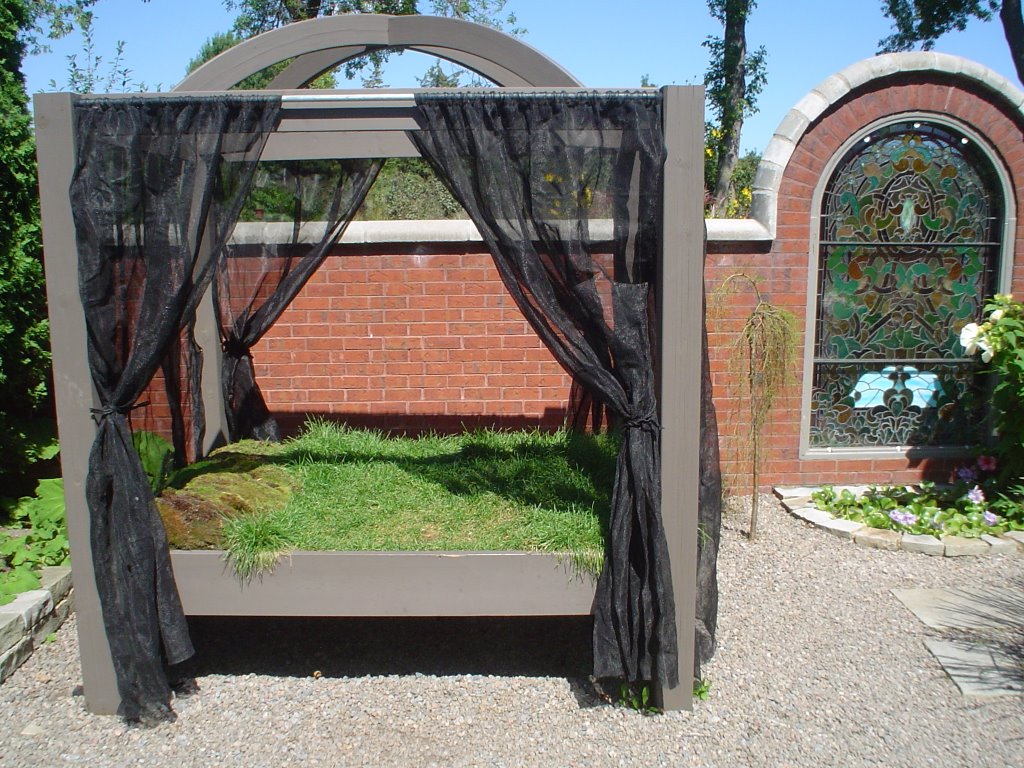
After our visit to the main flowers, we sat on a bench beside a pond, where ducks, quite domesticated, came up to us, almost smelling us like dogs do. My beloved feared that they would poke at my feet or bite me. They didn't. The six of them frolicked in the lake, swimming about and periodically dunking their heads so far down to feed that their bottoms went up vertically. We watched them for a while until a heron caught our eye by flying over the lake and landing in the brush. We rushed over to see it and watch it feed. It was gorgeous. After eating a while, it flew off.
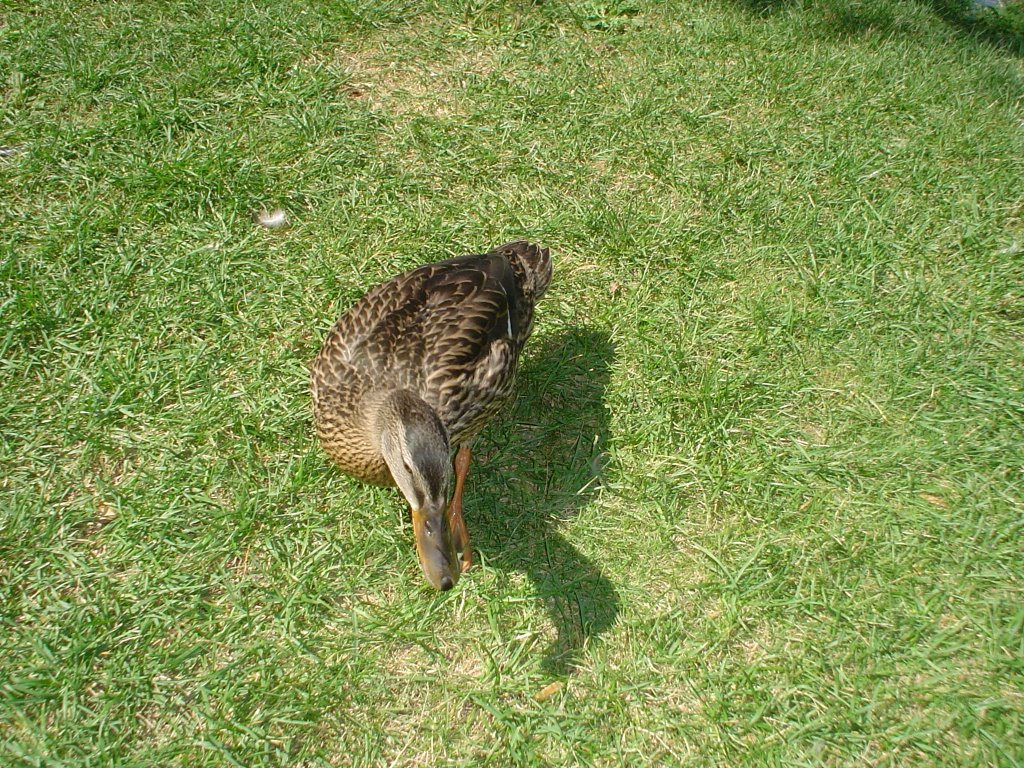

We walked on. There is a full Japanese and Chinese garden in the Botanical Garden as well as a garden that has the plants of high elevations - it reminded us of living in Colorado.
One of the best and most unique displays of the Botanical Garden is the "bug house." An interactive display that is a feast for entomologists. Bees and bugs and insects. It's great.
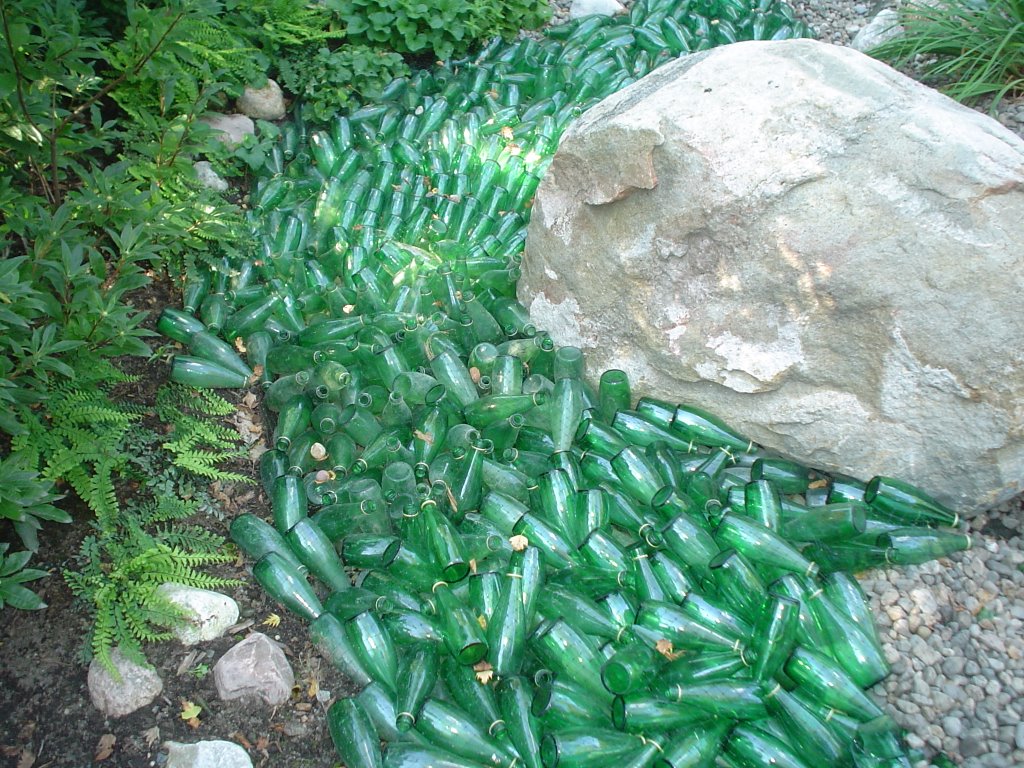
There is trolley that shuttles visitors about the Gardens. It was our last thing to do in the park. There is a huge Tree House that we didn't get to see and groves and groves of trees that we only saw from the trolley. While walking up to the gate, we notice the green bottle stream. It was magical. I was glad to get this photograph - and nearly a hundred others from this incredible day in the garden.
Saturday, September 02, 2006
What's Up with Stanford and Transgender People?
Two transgendered academics have come to my attention recently. Both tenured in science at Stanford University. The first is Joan Roughgarden. Her book, Evolution's Rainbow: Diversity, Gender, and Sexuality in Nature and People, is one of the texts for Women's Studies 698, Queers & Theory this semester. Roughgarden transitioned from male to female in the late 1990s. The Stanford News Service wrote about her new book here but the profile in the Stanford Alumni magazine is more interesting. In addition to Evolution's Rainbow, which apparently is written to question (or queer?) Darwin's theory of sexual selection, Roughgarden's newest book, Evolution and Christian Faith: Reflections of an Evolutionary Biologist. There is something delightfully queer about an eminent evolutionary biologist, who is also transgendered writing a reconciliation of evolution and Christianity. I'm interested in how her transgenderism is performed both in this text and in it's propagation.
The other academic is Ben Barres, also a professor at Stanford University. Barres has recently been responding to Larry Summers comments about women in science in an interview in The New York Times and in the Stanford University magazine. This summer Barre wrote in Nature magazine an article, Does Gender Matter? I've read less about Ben Barres to date, but will take up the Nature piece in the next few days.
I'm interested in these two people for a variety of reasons. First, from a queer perspective in the increasing ability of transgender people who have transitioned to maintain their professional positions - and in these cases not only maintain their professional careers, but to continue to expand and grow their professional lives. (Though I was discussing these two academics yesterday with a colleague who is a physicist outside of the academy and he immediately noted that both transitioned after their had received tenure.) This is a watershed event in the history of gender and for transgender people.
I'm also interested though in the issues of women, and gender, in science. Both for the individual scientists and for scientific theories of gender difference. I'm noodling around the implications of transgenderism amid my own assumptions and theories of both.
The other academic is Ben Barres, also a professor at Stanford University. Barres has recently been responding to Larry Summers comments about women in science in an interview in The New York Times and in the Stanford University magazine. This summer Barre wrote in Nature magazine an article, Does Gender Matter? I've read less about Ben Barres to date, but will take up the Nature piece in the next few days.
I'm interested in these two people for a variety of reasons. First, from a queer perspective in the increasing ability of transgender people who have transitioned to maintain their professional positions - and in these cases not only maintain their professional careers, but to continue to expand and grow their professional lives. (Though I was discussing these two academics yesterday with a colleague who is a physicist outside of the academy and he immediately noted that both transitioned after their had received tenure.) This is a watershed event in the history of gender and for transgender people.
I'm also interested though in the issues of women, and gender, in science. Both for the individual scientists and for scientific theories of gender difference. I'm noodling around the implications of transgenderism amid my own assumptions and theories of both.
Friday, September 01, 2006
My latest essay
My latest project, a limited edition folio titled Queer Culture: Our History and Our Legacy, is now posted in electronic version as a downloadable .pdf on the Woman-Stirred blog. Check it out and leave a comment.
Friday, August 25, 2006
Lake Placid was Serene, even placid
We spent two days in Lake Placid, which was long enough to relax, take in the town, and enjoy a fabulous dinner at what must be the best restaurant of Lake Place, the Brown Dog Cafe. It seems like a small place and it is. They serve a small deli menu which appears to be a favorite for lunch, but the dinner, with it's more elaborate though still modest in size menu, was incredible. I had a pumpkin-apple soup to start, which Kim enjoyed their crab-corn tortilla soup. Then we split a lobster salad. For our entrees, I had filet mignon and Kim had the roasted chicken. The best part is that they served three ounce pours of wine, so I had a different one with each course. If you're in Lake Placid, this is the best place to eat dinner. We watched the sunset on Mirror Lake throughout the meal, ate at a leisurely pace and then walked the "strip" of Lake Placid. Even after the fabulous wine from the Brown Dog Cafe, we picked up a little Bailey's from a local purveyor of spirits and made coffee back in the room. Even though it was still August, it was cold when the sun went down, but we sat on our porch at the hotel, warmed by Bailey's and coffee. It was a perfect evening.
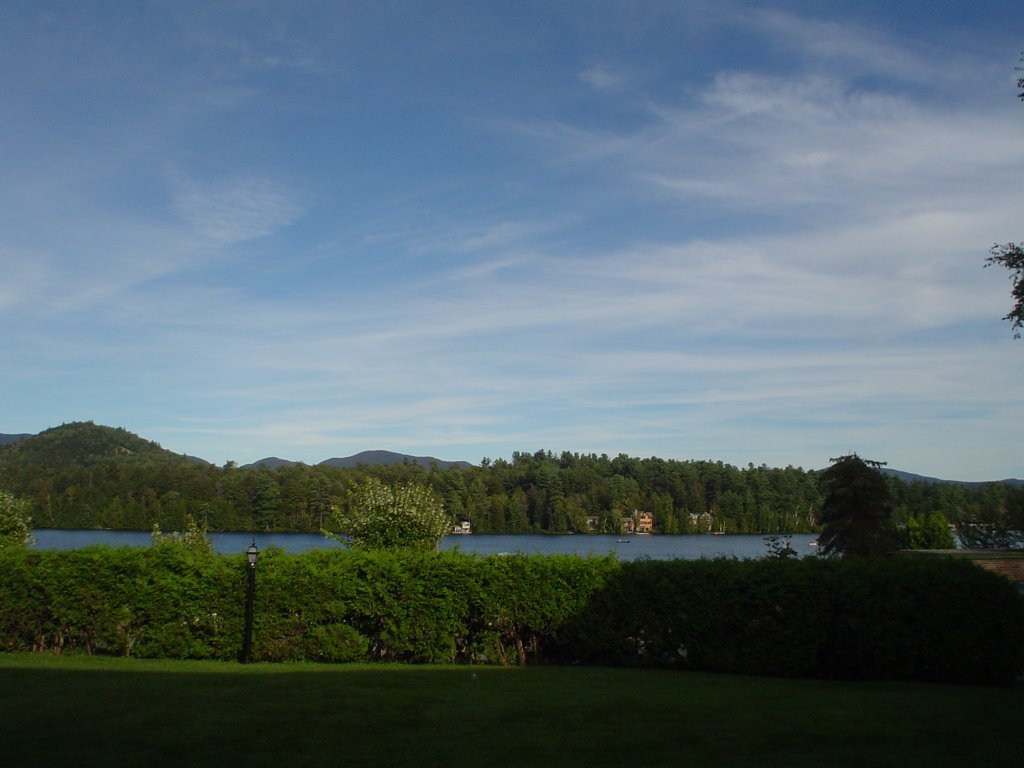
Here is the view from our room at the Hilton.

Here is the view from our room at the Hilton.

From New York to Montreal, everywhere we stayed were pro-choice signs. Perhaps in anticipation of the stunning new availability of "the Morning After" pill for U.S. women.
Sunday, August 20, 2006
Top Ten Essay Collections by Lesbians
I believe that essays are an important literary tool to talk about our lives and reflect on what is happening in the world. One of the things I think that we are missing more in our lesbian culture right now are journals and magazines that publish longer essays about our lives and our analysis of what is happening in our communities. We need that dialogue, written and recorded, to share with one another and build greater understandings between and among us. I thought about this today, in part, because of the article on the front page of the New York Times Style section and the lesbian communities' response to female-to-male transgender people. Where do we go to talk about the issues that it raises? I'm going to post it separately on my blog for that purpose, but I also want to take this opportunity to put together the list of the top ten essay collections by lesbians. It was more difficult than the list of contemporary lesbian poetry. The essay is an underutilized tool for our community. Hopefully, we can change that.
1. The Uses of the Erotic: the Erotic as Power by Audre Lorde
2. On Lies, Secrets, and Silence: Selected Prose by Adrienne Rich
3. Rebellion, Essays 1980-1991 by Minnie Bruce Pratt
4. My Mama's Dead Squirrel by Mab Segrest
5. My Lesbian Husband by Barrie Jean Borich
6. Skin: Talking about Sex, Class, and Literature by Dorothy Allison
7. A Restricted Country by Joan Nestle
8. Forty-three Septembers: Essays by Jewelle Gomez
9. Sister Outsider: Essays and Speeches by Audre Lorde
10. My American History by Sarah Schulman
A few notes:
1. I included two by Audre Lorde, there are others, particularly the essays of A Burst of Light, after her cancer diagnosis, but I think these two listed are most significant from a lesbian perspective.
2. I only included one by Adrienne Rich, but there are three or four others that could be included.
3. The most recent one on the list is Barrie Jean Borich's My Lesbian Husband--where are the current books of essays by lesbian feminists?
4. The Crossing Press and Firebrand Press are the most represented publishers on the list. Crossing Press is now out of business and Firebrand struggles and is only publishing a few books a year, I believe.
5. I think that all of these writers are not at least over forty, with Sarah Schulman and Barrie Jean Borich being the youngest--who are our new lesbian essayists?
1. The Uses of the Erotic: the Erotic as Power by Audre Lorde
2. On Lies, Secrets, and Silence: Selected Prose by Adrienne Rich
3. Rebellion, Essays 1980-1991 by Minnie Bruce Pratt
4. My Mama's Dead Squirrel by Mab Segrest
5. My Lesbian Husband by Barrie Jean Borich
6. Skin: Talking about Sex, Class, and Literature by Dorothy Allison
7. A Restricted Country by Joan Nestle
8. Forty-three Septembers: Essays by Jewelle Gomez
9. Sister Outsider: Essays and Speeches by Audre Lorde
10. My American History by Sarah Schulman
A few notes:
1. I included two by Audre Lorde, there are others, particularly the essays of A Burst of Light, after her cancer diagnosis, but I think these two listed are most significant from a lesbian perspective.
2. I only included one by Adrienne Rich, but there are three or four others that could be included.
3. The most recent one on the list is Barrie Jean Borich's My Lesbian Husband--where are the current books of essays by lesbian feminists?
4. The Crossing Press and Firebrand Press are the most represented publishers on the list. Crossing Press is now out of business and Firebrand struggles and is only publishing a few books a year, I believe.
5. I think that all of these writers are not at least over forty, with Sarah Schulman and Barrie Jean Borich being the youngest--who are our new lesbian essayists?
The New York Times: The Trouble When Jane Becomes Jack
August 20, 2006
The Trouble When Jane Becomes Jack
By PAUL VITELLO
SAN FRANCISCO
IN the most recent season of the lesbian soap opera, “The L Word,” a new character named Moira announced to her friends that, through surgery and hormone therapy, she would soon be a new person named Max. Her news was not well received.
“It just saddens me to see so many of our strong butch women giving up their womanhood to be a man,” one friend said.
The sentiment was a tamer version of what many other women wrote on lesbian blogs and Web sites in the weeks after the episode was broadcast last spring. Many called for the Max character to be killed off next season. One suggested dispatching him “by testosterone overdose.”
The reaction to the fictional character captured the bitter tension that can exist over gender reassignment. Among lesbians — the group from which most transgendered men emerge — the increasing number of women who are choosing to pursue life as a man can provoke a deep resentment and almost existential anxiety, raising questions of gender loyalty and political identity, as well as debates about who is and who isn’t, and who never was, a real woman.
The conflict has raged at some women’s colleges and has been explored in academic articles, in magazines for lesbians and in alternative publications, with some — oversimplifying the issue for effect — headlined with the question, “Is Lesbianism Dead?”
It has been a subtext of gay politics in San Francisco, the only city in the country that covers employees’ sex-change medical expenses. And it bubbles to the surface every summer at the Michigan Womyn’s Music Festival, a lesbian gathering to which only “women born as women and living as women” are invited — a ban on transgendered people of either sex.
Barbara Price, a former festival producer, said the uneasiness has been “a big topic among lesbians for quite some time.”
“There are many people who look at what these young women are doing, and say to themselves, ‘Hey, by turning yourselves into men, don’t you realize you’re going over to the other side?’ ” she said. “We thought we were all supposed to be in this together.”
Beyond the political implications, the sense of loss is felt most keenly in personal relationships.
“I am a lesbian because I am attracted to women, and not to men," said a 33-year-old woman who broke up with her partner of seven years, Sharon Caya, when Sharon became Shane. The woman, who asked to be identified only as Natasha, to protect family members who are unaware of her lifestyle, said that she was ultimately faced with the reality of her sexual orientation and identity. “I decided I couldn’t be in a romantic relationship with a man.”
The transgender movement among men is at least as old as the pioneering surgery that turned George Jorgensen into Christine Jorgensen in 1952. Among women who wish to become men, though, the movement has gained momentum only in the last 10 years, in part because of increasingly sophisticated surgical options, the availability of the Internet’s instant support network, and the emotions raised by the 1999 movie “Boys Don’t Cry,” based on the true story of the murder of Brandon Teena, a young Nebraska woman who chose to live as a man.
The word for the process is “to transition,” a modest verb for what in women usually means, at the minimum, a double mastectomy and heavy doses of hormones that change the shape of the face, deepen the voice, broaden the upper body, spur the growth of facial hair, and in some cases, trigger the onset of male pattern baldness.
Politically and personally, the change has equally profound effects. Some lesbians view it as a kind of disloyalty bordering on gender treason.
The Census Bureau does not try to count the number of transgendered people in the United States, and many who make the transition from one sex to another do not wish to be counted.
A European study conducted 10 years ago, and often cited by the American Psychiatric Association, says full gender reassignment occurred in 1 in 11,000 men and 1 in 30,000 women, a ratio that would place the number of men who have become women nationally at only about 13,000 and women who have become men at about 5,000.
Transgender advocates, however, say those statistics fail to reflect an increasing number of people, especially young people, who call themselves transgendered but resist some or all of the surgeries available, including, for women becoming men, the creation of a penis. Some delay or avoid surgeries because of expense. For women especially, the genital surgery is still risky.
“There are tens of thousands of us, probably more than 100,000,” said Riki Wilchins, the executive director of GenderPAC, a lobbying group in Washington, citing the looser definition of being transgendered.
Dr. Michael Brownstein, a surgeon in San Francisco, said he had performed more than 1,000 female-to-male surgeries in the last several years, and transgender advocates say there are a dozen surgeons specializing in the work in the United States.
The numbers are slight, considering the estimated five million gay men and five million lesbian women in the United States. Still, coupled with a simultaneous trend among the young to reject sexual identity labels altogether, some lesbians fear that the ranks are growing of women who once called themselves lesbian but no longer do.
“It’s as if the category of lesbian is just emptying out,” said Judith Halberstam, a gender theorist and professor of literature at the University of Southern California, San Diego, whose books include “Female Masculinity.”
Leaders of some lesbian organizations dismiss the idea of a schism or contend that it has been resolved in the interest of common human rights goals among lesbians, gays, bisexuals and transgendered people.
“The view in some lesbian corners that we are losing lesbians to transitioning is absurd,” said Kate Kendall, the executive director of the National Center for Lesbian Rights. “Given our history of oppression, all lesbians should encourage people to be themselves even if it means our lesbian sister is becoming our heterosexual-identified brother.”
But in private conversations and in public forums like women’s colleges, the questions about how to frame the relationship among lesbians, former lesbians and young women who call themselves “gender queer” rather than lesbian at all, seem largely unresolved.
“There is a general uneasiness about this whole thing, like ‘What are we losing here?’ ” said Diane Anderson-Minshall, the executive editor of Curve, a lesbian magazine. The issue stirs old insecurities about women being “not good enough,’’ she added.
Koen Baum, a family therapist in San Francisco who is a transgendered man, said the anxiety some lesbians feel has complicated roots. Some, he said, believe that women who “pass” as men are in some ways embracing male privileges.
Ben A. Barres, a professor of neurobiology at Stanford and a transgendered man, recently provided fodder for that view in an article in Nature and an interview with The New York Times. “It is very much harder for women to be successful, to get jobs, to get grants, especially big grants,” he told The Times.
The idea of male privilege was also part of “The L Word” plot: When Max learns he is to be offered a job that he was rejected for as Moira, he promises that he will refuse it and tell off the would-be boss, but he later decides to take the job and say nothing.
Mr. Baum said the anxiety also stems from fear over the loss of an ally in the struggle against sexism. “The question in the minds of many lesbian women is, ‘Is it still going to be you and me against sexism, you and me against the world?’ ” he said.
There are also practical questions: What place should a transgendered man have in women’s spaces such as bathhouses, charter cruises, music festivals and, more tricky still, at women’s colleges, where some “transmen” taking testosterone are reportedly playing on school sports teams?
Laura Cucullu, a freelance editor and recent graduate of Mills College in Oakland, Calif., phrased the question this way: “When do we kick you out? When you change your name to Bob? When you start taking hormones? When you grow a mustache? When you have a double mastectomy?”
The fact that there is no apparent parallel imbroglio in the gay community toward men who become women is a subject of some speculation.
“There is the sense that a transman is ‘betraying the team,’ joining the oppressor class and that sort of thing,” said Ken Zucker, a clinical psychologist and a specialist in gender research at the University of Toronto.
Despite the tangled set of issues involved, the survival rate of lesbian couples seems higher than among gay couples when one partner changes gender, advocates say.
After Susie Anderson-Minshall became Jacob several years ago, he and his partner of 15 years, Ms. Anderson-Minshall, the Curve editor, decided to marry. Their March 19 wedding was actually their second union. The first had been a partnership ceremony as lesbians; the second was as legally recognized husband and wife under the laws of the state of California, where they live.
Other couples, like the former Sharon Caya and Natasha, found the transition much rougher. Sharon’s decision to become Shane coincided with Natasha becoming pregnant, having conceived with donor sperm. “When the baby came along, I wanted to become myself,” Mr. Caya said. “I wanted the baby to know me as I truly am.”
She began taking testosterone about three years ago, then had “top surgery” — a double mastectomy — and is now a muscular 42-year-old of medium height with long sideburns and a goatee.
For financial and practical reasons, Mr. Caya, the legal director of the Transgender Law Center in San Francisco, decided to forgo “bottom surgery,” which could cost as much as $100,000 and would involve two or three operations to graft on an ersatz penis.
According to the standards of the European study, Shane Caya would not be counted as a transgendered person.
Natasha, a financial manager in San Francisco, still cries when describing Sharon’s decision to become male.
“You’re in love with a person, but there is something about gender that is so central to identity it can be overwhelming if the person changes,” she said.
“When she told me what she wanted to do, I was completely blown away at first,” Natasha said. Then, “I thought to myself, ‘All right, we’re good lesbians. We should be able to figure this out.’ ”
But after a month of struggling with the idea, Natasha said she could not make the adjustment. The breakup occurred when the child was 5 months old. The couple remain on friendly terms and share custody.
And when Mr. Caya attended a lesbian organization’s lunch recently, he recalled, he was welcomed by a woman who said she was “pleased to see a man supporting us lesbians.” His reply, he said, was quick and to the point:
“Of course I support lesbians,” he said. “I used to be one.”
The Hyde Collection
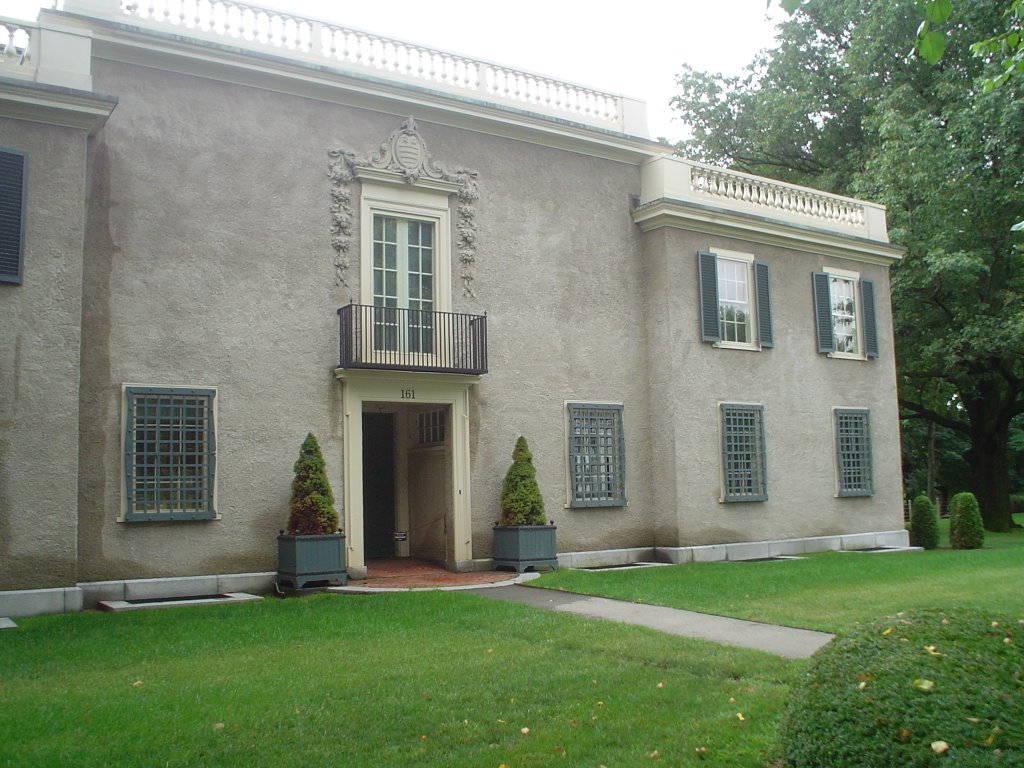
Ever since the Barnes, we are in search of small museums with amazing collections. The Barnes, especially in the original home of it's founder, is an experience like no other. First the home is huge, but not by museum standards. It is huge by home standards, but by contemporary museum standards, it is small. Filled with master artworks that were arranged by Dr. Barnes for teaching purposes - to emphasize a use of color, a type of form in art - the house is at one overwhelming and uplifting in its density and great beauty. We were hoping that the Hyde Collection would be like that.
We arrived in Glen Falls, NY at about 11:15 the morning. It is an old and small industrial town. The smell of sulfur was in the air. Most things were closed on Sunday morning, but we found a small coffee shop to have a cup and write out some postcards. The museum opened at 12 noon and we were there. Similar to the Barnes, the Hyde Collection is housed in the home of the original family that purchased the artwork. The collection is similar to the Barnes as well in terms of focus on Impressionists, but the family also collected other masterworks. One of the most stunning pieces was a sketch attributed to Leonardo da Vinci that is an early Mona Lisa, with a number of differences. It was extraordinary. There was also a large collection of furniture that was beautiful as well as French tapestries. Textiles are always a weakness of mine--one of the guest beds was covered in toile. I told Kim, this is the room that I would want to stay in when I visited. Original Botticellis and Rembrants were on display. As well as Degas sketches and a thimble collection. It was a lovely visit.
What I missed though at the Hyde Collection was the density of the Barnes. I believe that when Mrs. Hyde lived in the home it had more of the density that Dr. Barnes had, but now, managed by professional museum curators, the collection has been pared down in what is displayed on a daily basis to reflect the aesthetics of the current U.S. museum standards. It was less overwhelming, but also less breathtaking as a result. Still, the security guards indicated that the over 3,000 holdings are rotated regularly in the Collection so it would be the sort of place to visit every other month if one were lucky enough to live close to Glen Falls. Either way, it's worth a stop when driving up I-87 in New York.
Tonight, we are at the Hilton Hotel in Lake Placid. Moving from the high-brow artwork of the Hyde Collection this morning to the popular, Snakes on a Plane, after dinner made it a full and satisfying day in the vacation world.
Franklin Delano Roosevelt Library and Museum
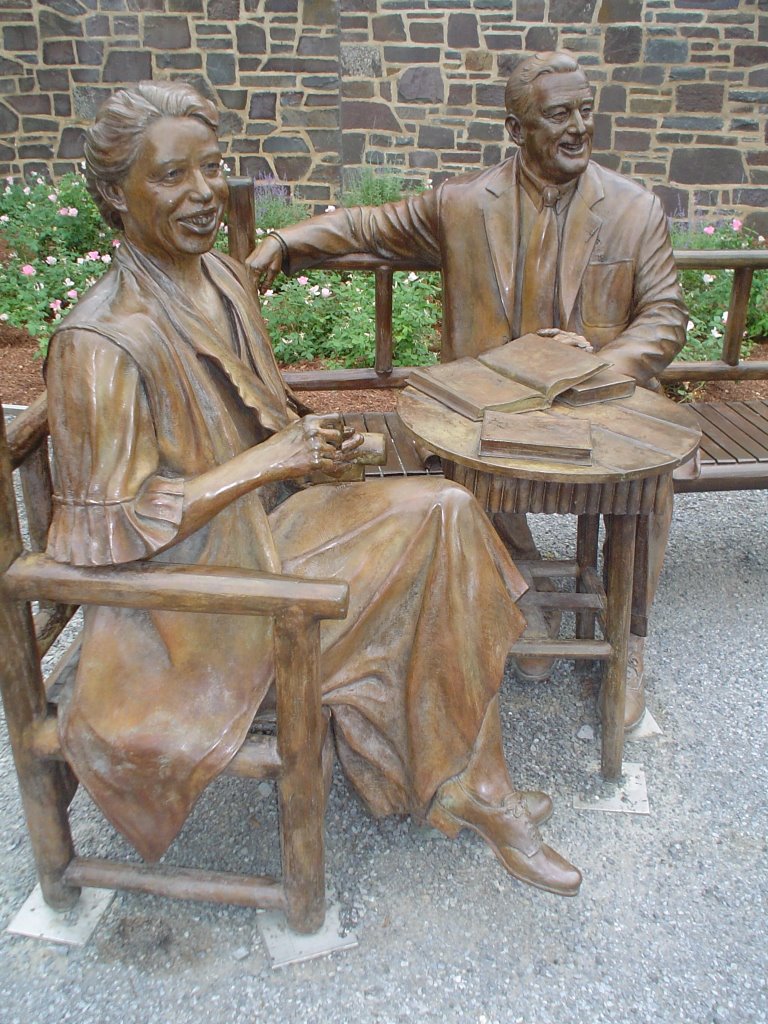
We made an unanticipated stop on our trip to Montreal: the Franklin Delano Roosevelt Library and Museum. The FDR Memorial in Washington, DC is a favorite monument for us to bring visitors. It is compelling, not only because they have a statue of Falla, FDR's dog, but also because the vision of FDR of government helping people in the United States and around the world is a compelling one and an important one for us to remember in this dark time of US imperialism and selfishness led by the current POTUS. So seeing that FDR's childhood home in Hyde Park, NY was just off the road that we were traveling was too much for us to resist. We stopped. I really wanted to see Val-Kill, the home of Eleanor, especially after Franklin died, but it was closed for renovations. We decided to see FDR's childhood home and the Presidential museum and library instead. It was well worth the time. The guidebooks recommend a minimum of ninety minutes to see the site and it is worth every minute. We started with a film that covered FDR's presidency. Then went on the walking tour of the home and finally went to see the rose garden of FDR's mother, Sarah Delano, and then the library and museum. All were delightful.
There was a video in the library that we only watched for a few minutes as it presented a rather antiquated view of Eleanor as the reclining flower coming to bloom only through FDR's nurturance. We didn't spend long watching it. I have committed to reading Blanche Weisen Cook's two volume biography of Eleanor--long but I hope it will be well worth it. Except for that small quibble, (which would have, I'm sure been much larger and even a rant instead of a quibble had we watched more of the film) FDR's library and museum is a treat.

Subscribe to:
Comments (Atom)

